
Live Edge vs Resin River Tables: An Honest Comparison
What separates a live edge table from a resin river table, where each works best, and how to choose between them.
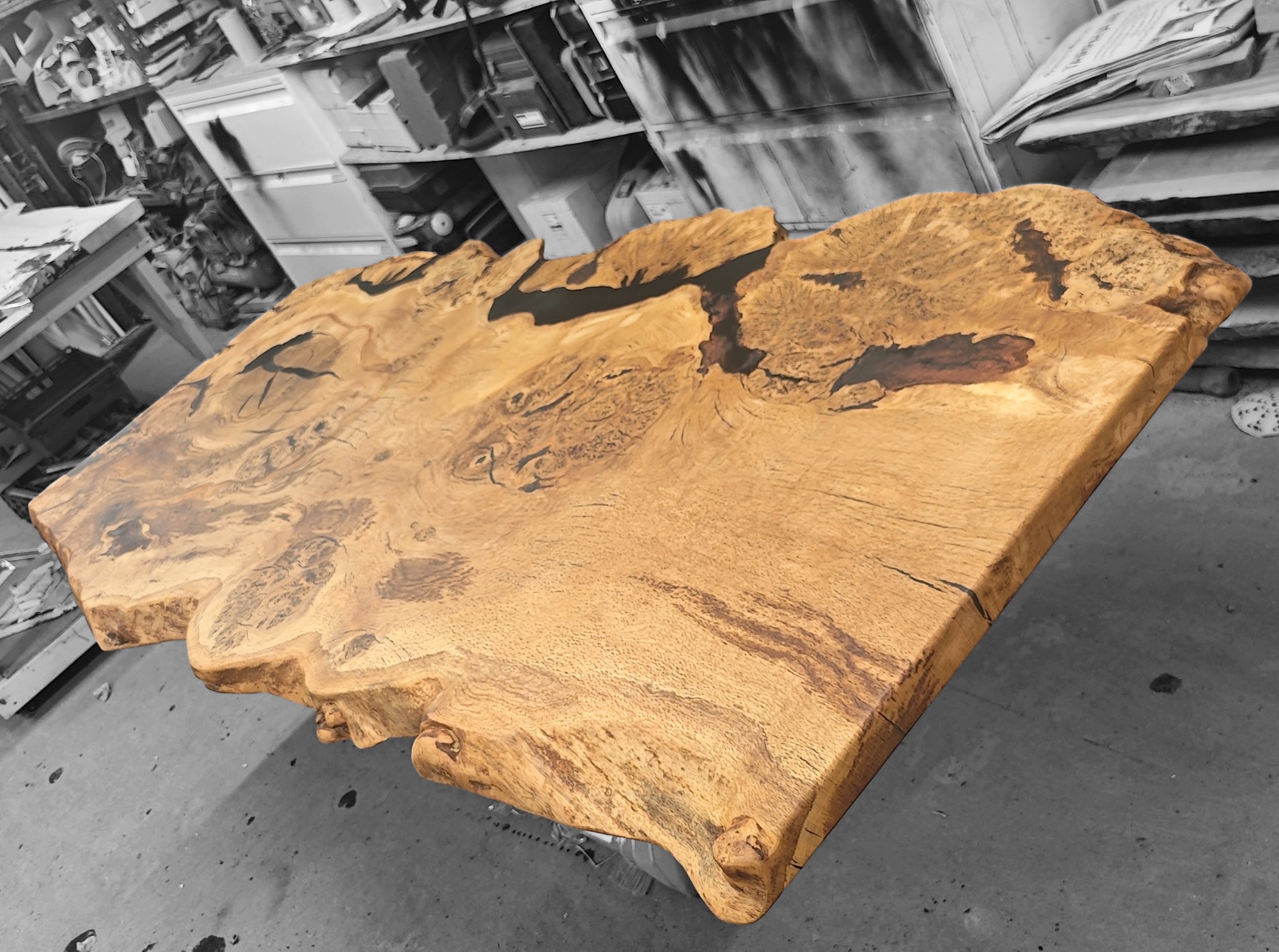
A live edge table keeps the natural outer edge of the tree and lets the wood do all the talking. A resin river table adds a band of coloured epoxy resin between the slabs, or through the natural cracks and voids, for a bolder and more designed look. Neither is better: choose live edge if you love wood as it grows, and resin if you want colour and a centrepiece that looks unlike anything else in the room. We make both.
What the two terms mean
Live edge
A live edge (sometimes called a waney edge) is the natural outer edge of the slab, preserved rather than cut straight. It is our signature edge style. Every live edge is different, and we work with you during the build so the contour suits your taste, whether that is a subtle wave or something much wilder.
Any edge that isn’t live, such as the two ends of a dining table, gets a chamfered edge by default. You can mix edge styles too: a desk that sits against a wall can have a square back edge and a live front edge.

Resin river
A resin river is epoxy resin poured into the gap between two slabs, so that it runs down the table like a river between two banks. In most designs the live edges of the slabs face each other across the resin, so a resin river table is really a live edge table turned inside out.
We design each resin river to your specification, in the colour of your choice, then finish the whole top with multiple coats of Osmo high-gloss oil for depth and clarity.

Side by side
| Feature | Live edge | Resin river |
|---|---|---|
| Overall look | Natural and organic; the wood is the whole story | Bold and graphic; the resin becomes the focal point |
| Colour | The colour of the timber, or a stain such as our walnut colour for French oak | Any resin colour you choose, alongside the timber |
| Surface finishes we offer | Matt (Rubio Monocoat Pure) or high gloss (multiple coats of Osmo high-gloss) | Multiple coats of Osmo high-gloss oil |
| Direct sunlight | Wood colour naturally changes with age, light and oxidation | Epoxy has poor UV resistance and can yellow in strong, prolonged sun |
| Wood movement | The timber moves with humidity, so it must be properly dried | Exactly the same: the resin doesn’t stop the wood moving |
| Suits | People who want the timber itself to be the feature | People who want colour, contrast and a one-off statement |
The honest practical differences
Sunlight
This is the biggest real difference. Epoxy, tinted or clear, does not have good resistance to ultraviolet light. Epoxyworks, the technical publication from Gougeon Brothers, makers of West System epoxy, puts it plainly: an epoxy coating exposed to UV will yellow, become opaque and eventually flake off. The same source notes that this takes a while, and that where sunlight exposure is limited a coloured epoxy coating will hold up for years.
So if your table will sit indoors out of strong direct sun, it isn’t a reason to avoid resin. If it will sit in a conservatory or right beside large south-facing glazing, tell us, because that changes the advice. Wood changes colour in sunlight too, but that is part of its natural ageing.
Movement
Solid wood takes up and gives off moisture as the air around it changes, and it shrinks and swells across its width as a result. Adding resin doesn’t change that. A resin river top still needs slabs that were dried properly before any resin went near them. Ours are kiln-dried to a moisture content of 8% or below. Our guide to why solid wood tables split and warp goes into the detail.
Everyday care
Day to day, the two are looked after in the same way: wipe up spills promptly, use mats or trivets under hot dishes, and keep the table away from direct heat sources such as radiators and log burners.
Changing your room later
A natural wood table goes with almost any colour scheme. A bright blue or green river is a stronger commitment, so if you redecorate every few years, a subtle resin colour or a plain live edge keeps your options open.
The middle ground: resin in the natural features
You don’t have to choose between a full river and no resin at all. Some of the most characterful slabs have natural cracks, voids and burrs. For French oak we can source slabs with large cracks and infuse them with resin, and the swirling figure of burr oak can be highlighted with resin in the same way. The result reads as a wood table first, with the resin picking out the character of the tree.

Cost and timing
Budgets for our bespoke tables run from roughly £2,000 to £10,000+, depending mainly on the rarity of the wood and the size of the table, and custom tables currently take 4 to 5 weeks to make. Every resin design is different, so the simplest way to compare is to ask us to quote both versions of the same table. Delivery is free and our team installs the table where you want it.
How to choose
Ask yourself four questions:
- Do you want the table to be about the wood, or about colour and contrast?
- Will it sit in strong, direct sunlight for much of the day?
- How often do you change your room’s colour scheme?
- Do you want a matt finish? If so, plain live edge gives you the choice of Rubio Monocoat Pure matt; our resin river tables are finished in high-gloss oil.
If you answered “the wood”, “yes”, “often” or “matt”, start with live edge. If you answered “colour”, “no”, “rarely” and you like a gloss finish, a resin river could be the right table for you. If you are still unsure what wood to use, our French oak vs English elm guide compares two of our most popular choices.
Tip: when you ask for a quote, tell us the colours already in the room, such as a paint name or a photo of your curtains or chairs. It makes it much easier for us to suggest a resin colour that sits well with them.
Quick answers
Do you make resin river tables?
Yes. We design resin rivers to order in any colour and finish them with multiple coats of Osmo high-gloss oil. We also make plain live edge tables, which are our signature style.
Will a resin river table turn yellow?
Epoxy has poor resistance to UV light, so long exposure to strong direct sunlight can yellow it. Where sun exposure is limited, the makers of West System epoxy say a coloured epoxy coating will hold up for years.
Can I have a live edge on one side only?
Yes. We can combine edge styles, for example a square edge against a wall and a live edge on the open side.
Is a resin river table more stable than a live edge table?
No. The wood either side of the resin still moves with the seasons, so properly dried timber matters just as much.
Compare both on your own table
Send us your size and wood preference and we will quote a plain live edge and a resin river version side by side.
Request a free quote or call 01245 79 0182
Keep reading
More buying guides
 What Size Dining Table Do You Need? Seats, Space and ShapesHow much table length each person needs, the best width and height, and how much clear space to leave around the table.Read the guide
 Why Solid Wood Tables Split and Warp (and How We Prevent It)Why solid wood moves, what causes splits and warping, and how kiln drying, sensible placement and simple care keep a table stable.Read the guide
 Choosing Steel Legs for a Live Edge or Slab TableLeg styles, height, legroom, steel thickness and powder coating: what to check when choosing steel legs for a heavy slab top.Read the guide