
Choosing Steel Legs for a Live Edge or Slab Table
Leg styles, height, legroom, steel thickness and powder coating: what to check when choosing steel legs for a heavy slab top.

Choose the leg style for the look you want, then check four practical things: the right height for the top’s thickness, legroom for anyone sitting at the ends, a steel section strong enough for a heavy slab, and a powder-coated finish so bare steel never touches the wood. Our steel bases are custom fabricated to fit the top they will carry, and powder coated in any RAL colour you choose.
The main leg styles
Almost every slab table base falls into one of a few families. Browse our legs and bases gallery to see each one on real tables.
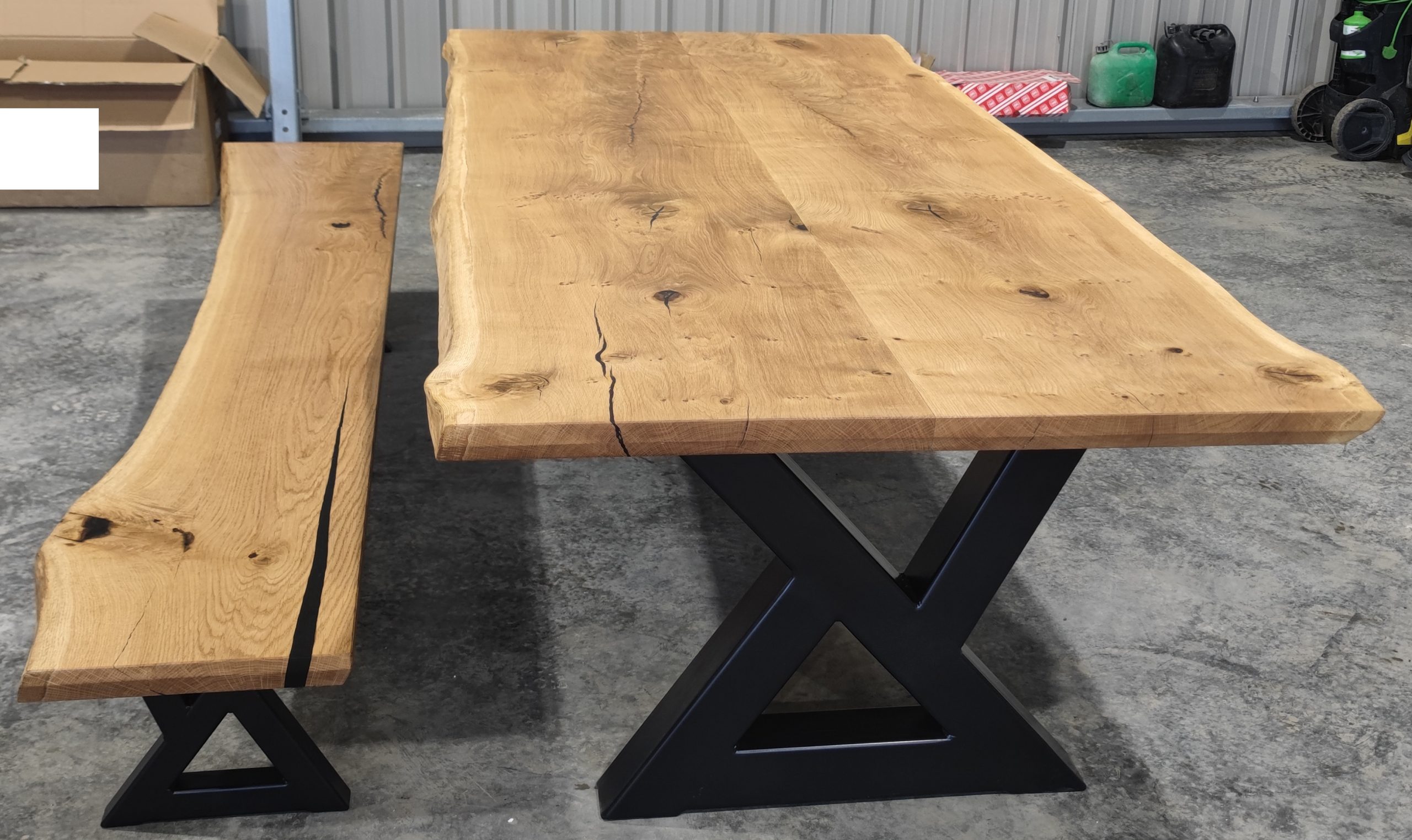
- Frame legs. A pair of closed frames, one near each end of the table. Simple, strong and easy to pair with a matching bench.
- X and hourglass frames. Crossed or tapering frames with a more dynamic outline. Our Shapeshifter legs are a good example.
- A-frame legs. Legs that splay outwards towards the floor, giving a wide, stable footprint.
- Pedestal and twin pedestal bases. Sculptural bases set in towards the middle of the table, such as our Kruna and Dentra designs. Because they sit away from the ends, they leave more room for knees at the ends.
- Steel art legs. Sculptural designs, including the Haro legs we have fitted to coffee tables.
- Wooden legs. If you would rather not have steel, we make solid oak legs, stained to any colour, in styles including A-frame and X.
Getting the height right
The standard finished height for a dining table is around 75cm, and for a coffee table 45cm. That is the height to the top surface, so the legs have to be shorter by the thickness of the slab. A 5cm-thick dining top needs legs of about 70cm. A thick burr oak top, which can finish at up to 60mm, needs legs of about 69cm.
This is why a base should be made to order for the top it will carry. We fabricate each base to the precise dimensions of your tabletop, so the finished height comes out exactly where you want it.
Legroom: where the legs sit matters
The US National Kitchen and Bath Association (NKBA) planning guidelines allow a knee space 61cm wide and 46cm deep for each person at a table around 76cm high. Two things follow for a slab table:
- People at the ends need knee depth. If you want someone sitting at each end, the leg frames need to sit far enough in from the ends to leave roughly that 46cm of depth. A pedestal base does this naturally.
- Watch anything running under the top. Cross rails and frames under the top eat into thigh room. For accessible seating, the NKBA recommends a knee space at least 686mm high. A 75cm table with a 5cm top leaves about 70cm underneath, which is only just enough, so any rail beneath the top needs careful thought.
For a live edge table, also make sure the feet sit inside the narrowest part of the edge, so they don’t stick out beyond the top where people can catch them with their toes. Our dining table size guide covers seating and room space in more detail.
Weight and steel thickness
Solid slabs are heavy, and the base has to carry that weight without flexing or wobbling. Using average dried weights from the Wood Database, a top 2.4m long, 1m wide and 5cm thick weighs roughly:
| Species | Average dried weight | Approximate weight of a 2.4m x 1m x 5cm top |
|---|---|---|
| English elm | 565 kg/m³ | About 68kg |
| European oak | 675 to 710 kg/m³ | About 81 to 85kg |
Using the same oak figures, a single-slab burr oak top 2.4m long, 1.2m wide and 6cm thick comes to roughly 115 to 125kg. Add the people leaning on it and the base needs real stiffness.
That is why we build our legs from thick, heavy steel. Our Shapeshifter legs, for example, are made from 100mm x 100mm box section with 4mm walls. Published section tables put that size of box section at about 11.7kg for every metre of steel. We grind every weld smooth, so each base reads as a single, seamless piece.

Powder coating, colour and protecting the wood
What powder coating is
Powder coating is a dry finishing process. A fine powder of resin and pigment is sprayed onto the steel with an electrostatic charge, then melted and fused into a uniform coating in a curing oven. The industry magazine Products Finishing describes powder-coated finishes as resistant to scratches, corrosion, abrasion, chemicals and detergents.
Choosing a colour
We powder coat our legs in any RAL colour. RAL is a colour standard that identifies each shade with a four-digit code, and its RAL CLASSIC collection alone runs to 216 shades. Examples include RAL 9005 Jet black and RAL 7016 Anthracite grey, but you can equally pick a colour to suit your kitchen or dining room.
Why it matters for oak
Oak contains large amounts of tannin-like extractives. According to the US Forest Products Laboratory, that makes it particularly prone to iron stain, a blue-black discolouration caused when those extractives react with iron in steel, typically when water lets the two meet. The laboratory’s advice is that steel in contact with wood must not corrode, which can be achieved by using stainless steel or by coating the steel. A powder-coated base does exactly that, and indoors, where the wood stays dry, no discolouration occurs.
Tip: wipe up spills that run down to where the legs meet the top rather than leaving them to sit. The coating protects the wood, but keeping that joint dry is good practice with any oak table.
Matching the legs to the slab
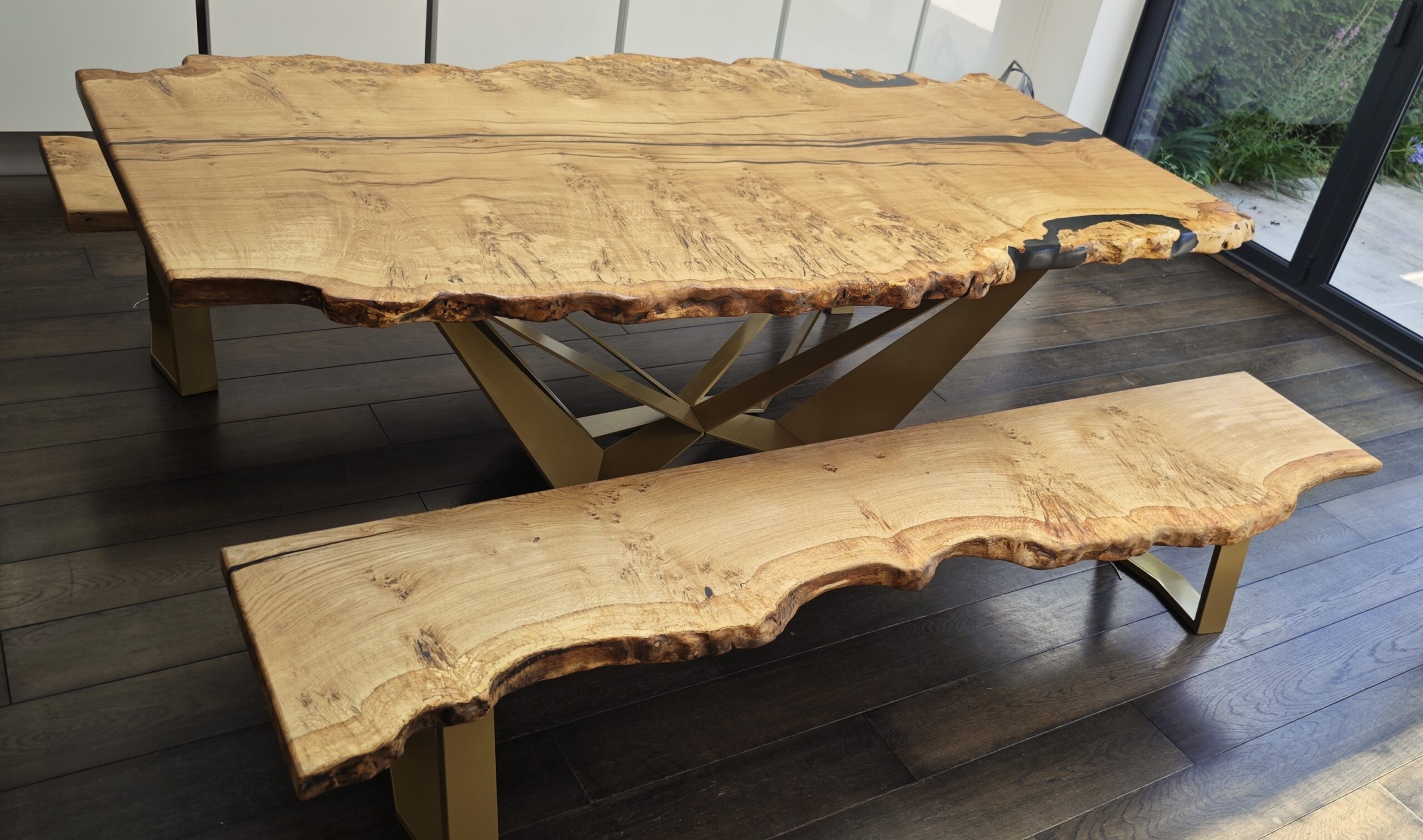
- Match visual weight. A thick slab looks best on a substantial base; heavy box-section steel gives the solid, imposing look that suits a thick top.
- Match the character. A calm French oak top suits clean frame or X legs, while a wild English elm or burr slab can carry a sculptural base. Our French oak vs English elm guide compares the two woods.
- Think about the bench. We can make matching bench legs so the table and bench read as a set.
- Consider coffee tables separately. At 45cm high there is no legroom to worry about, so you can be bolder with the design.
Buying legs on their own
If you already have a top, you can buy our steel table legs and bases separately. Our online shop lists many designs, and we can make any of them to a bespoke size. The gallery also includes designs not yet listed in the shop; email us for a price.
Quick answers
How tall should dining table legs be?
Take the finished height you want, usually around 75cm, and subtract the thickness of the top. A 5cm top needs legs of about 70cm.
Will steel legs stain an oak table?
Bare, corroding steel can cause blue-black iron stain on oak when moisture is present. Coated steel prevents it, which is why we powder coat our steel legs.
What colours can steel table legs be?
Any RAL colour. The RAL CLASSIC range alone has 216 shades, from RAL 9005 Jet black to bright colours.
Can I buy steel legs without a tabletop?
Yes. Our shop sells legs and bases on their own, and we can make bespoke sizes.
Design your base with us
Send us your tabletop size and the style you like, and we will quote for legs fabricated to fit it exactly.
Request a free quote or call 01245 79 0182
Keep reading
More buying guides
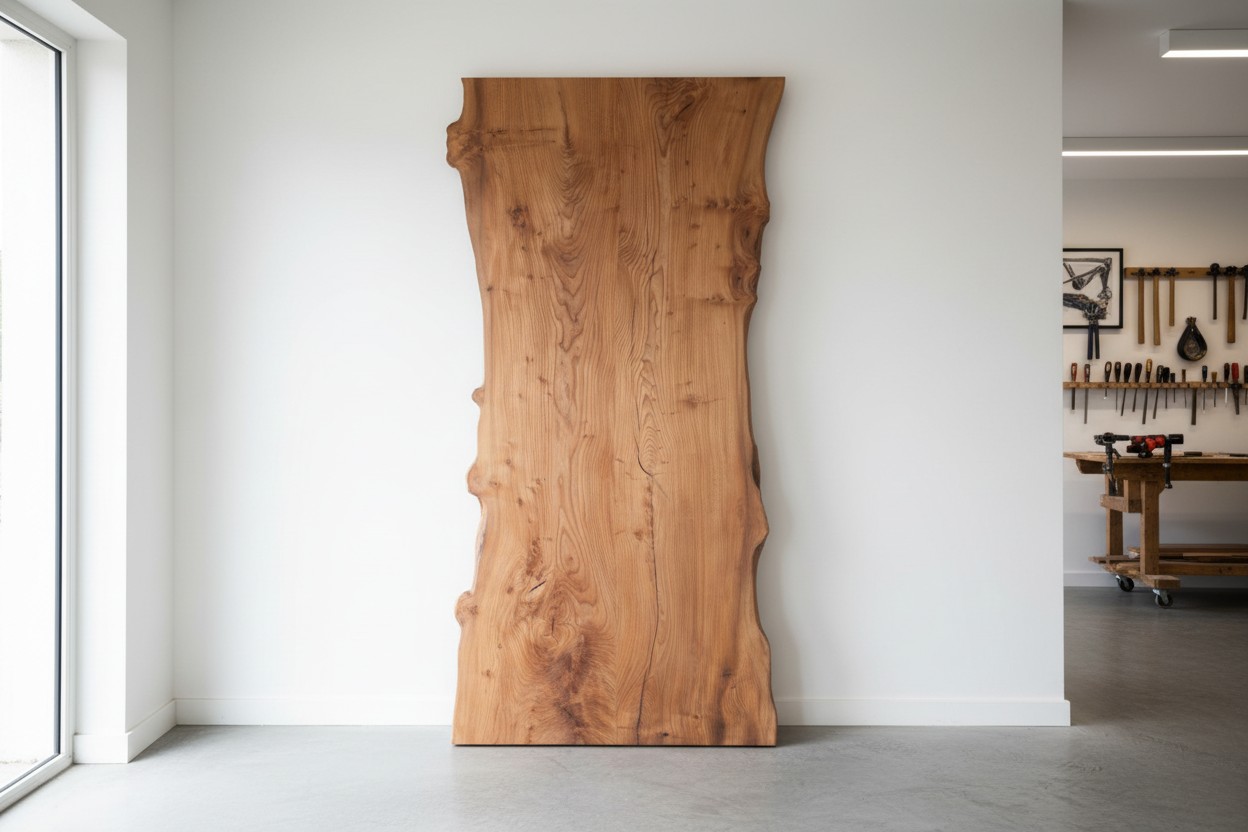 French Oak vs English Elm: Which Wood for Your Dining Table?How French oak and English elm compare on colour, grain, hardness, stability and rarity, and which one suits your dining room.Read the guide
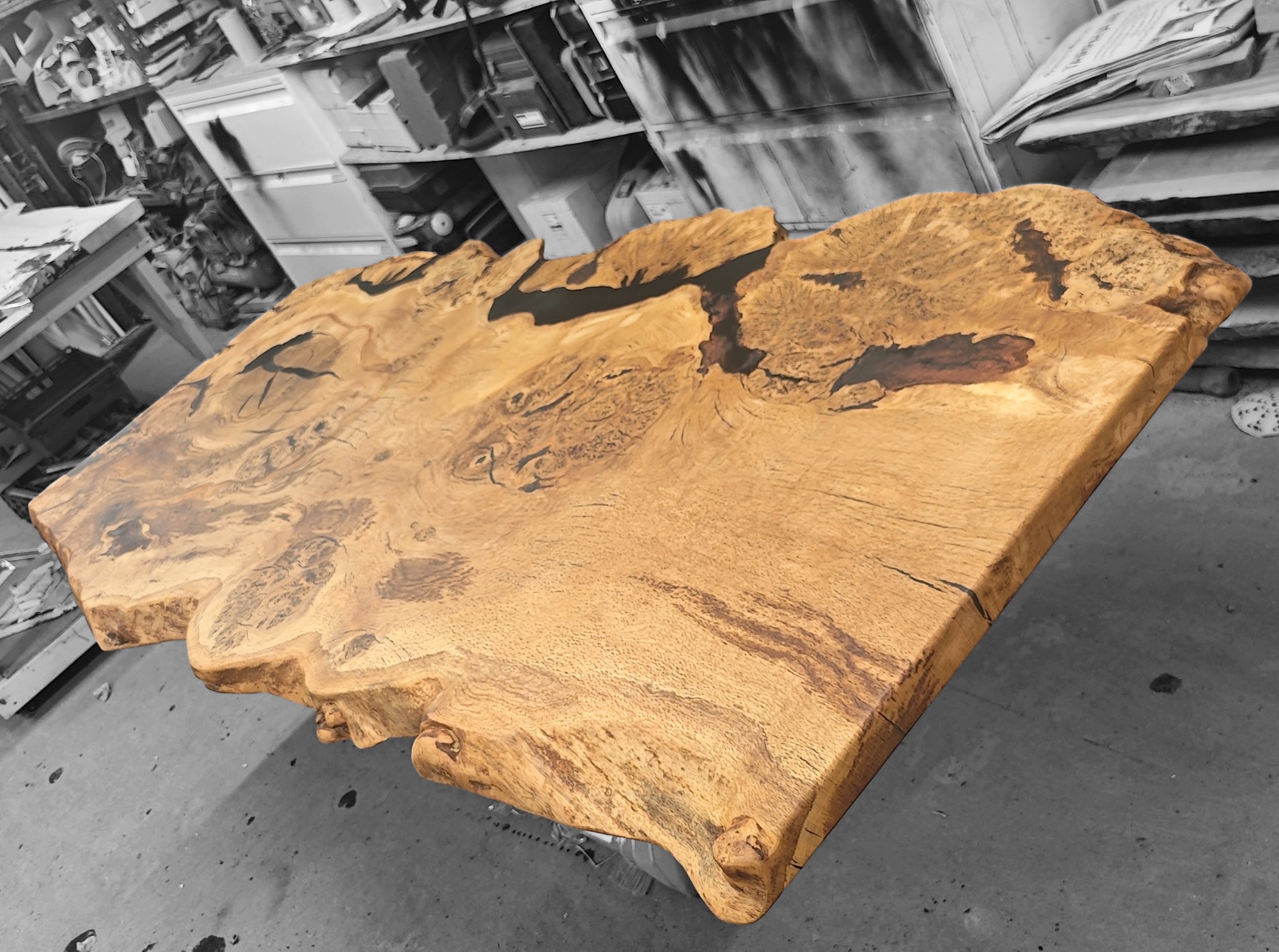 Live Edge vs Resin River Tables: An Honest ComparisonWhat separates a live edge table from a resin river table, where each works best, and how to choose between them.Read the guide
 What Size Dining Table Do You Need? Seats, Space and ShapesHow much table length each person needs, the best width and height, and how much clear space to leave around the table.Read the guide