
French Oak vs English Elm: Which Wood for Your Dining Table?
How French oak and English elm compare on colour, grain, hardness, stability and rarity, and which one suits your dining room.
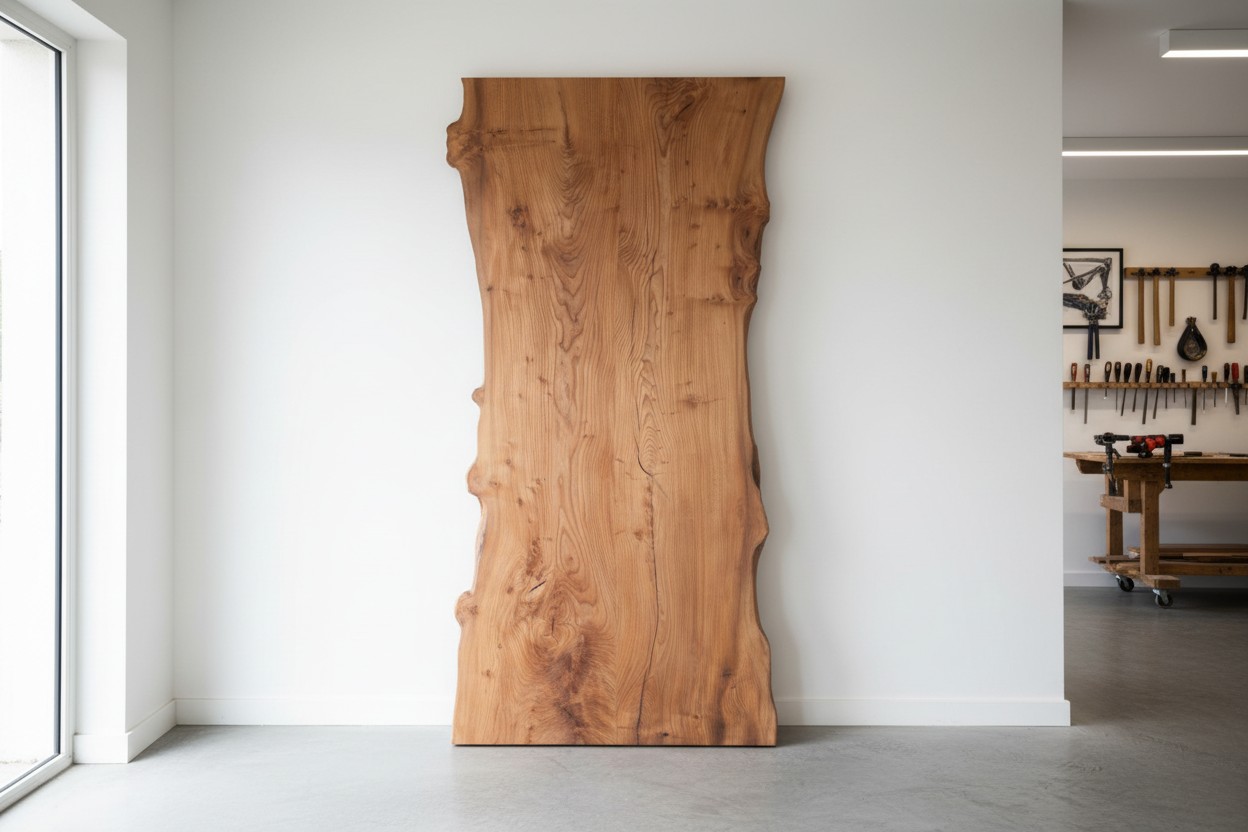
Choose French oak if you want a calm, even grain, a harder surface and the option of a natural or walnut colour. Choose English elm if you want wild grain, dramatic live edges and a timber that has become genuinely scarce. Both make excellent dining tables, and how well the slabs have been dried matters more than which species you pick.
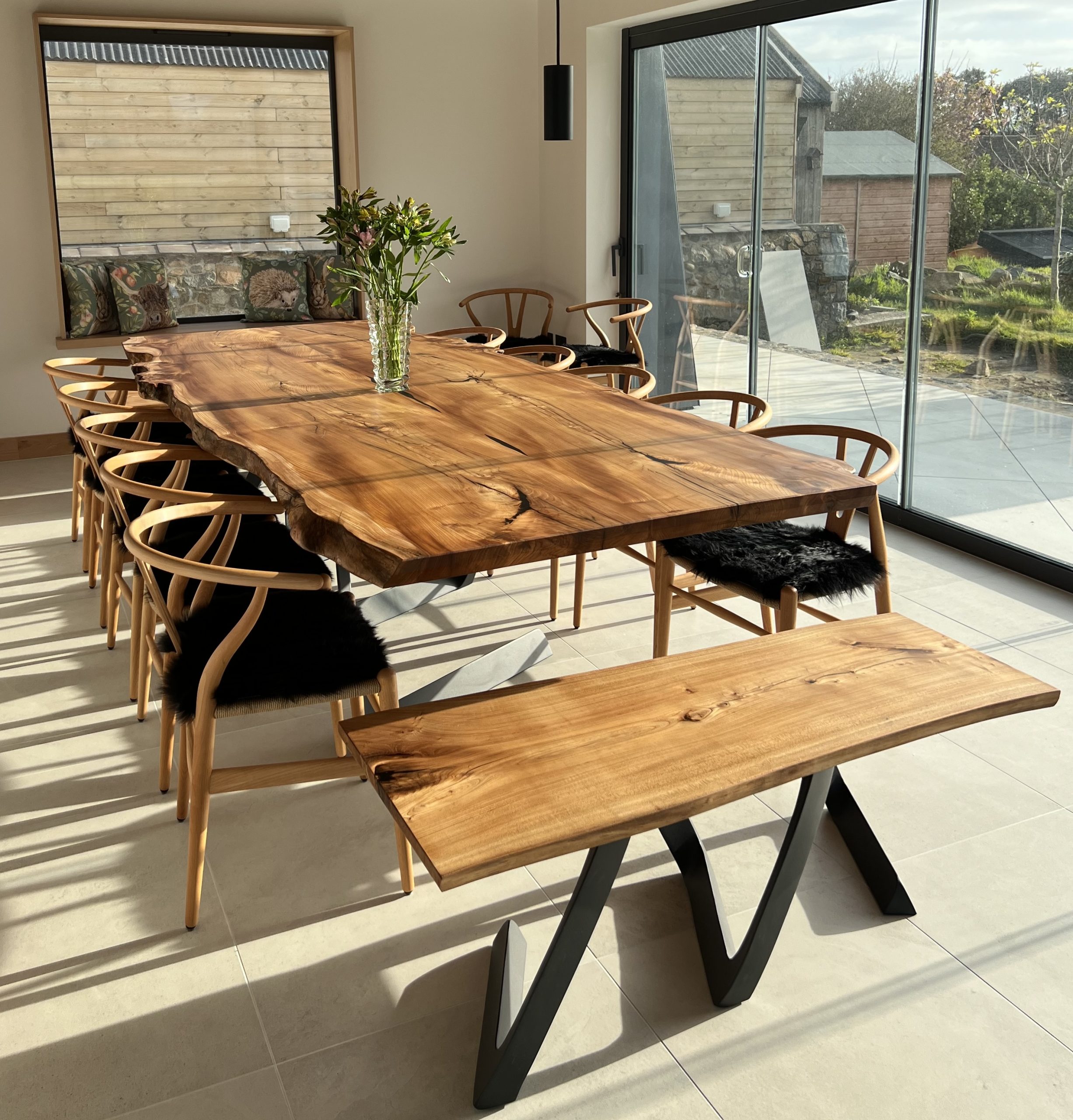
French oak and English elm at a glance
| Feature | French oak | English elm |
|---|---|---|
| Species | Pedunculate and sessile oak (Quercus robur and Quercus petraea), the two oaks that dominate French forests | Ulmus procera |
| Colour | Light to medium brown, often with an olive cast. We offer it natural or stained to a walnut colour | Light to medium reddish brown heartwood, with paler, clearly defined sapwood |
| Grain and edges | Mostly straight grain; live edges tend to be fairly straight and uniform | Interlocked grain; live edges range from fairly straight to very wild |
| Janka hardness | About 1,120 lbf (4,980 N) | About 810 lbf (3,620 N) |
| Average dried weight | 675 to 710 kg/m³ | About 565 kg/m³ |
| Resistance to splitting | Prone to checking while it dries, so drying has to be slow and careful | Interlocked grain makes it very resistant to splitting |
| Movement class (TRADA) | Medium | Medium |
| Widest top we make | Up to 1.5m from two slabs | Up to about 1.3m from two slabs, or 1.5m from three |
How they look
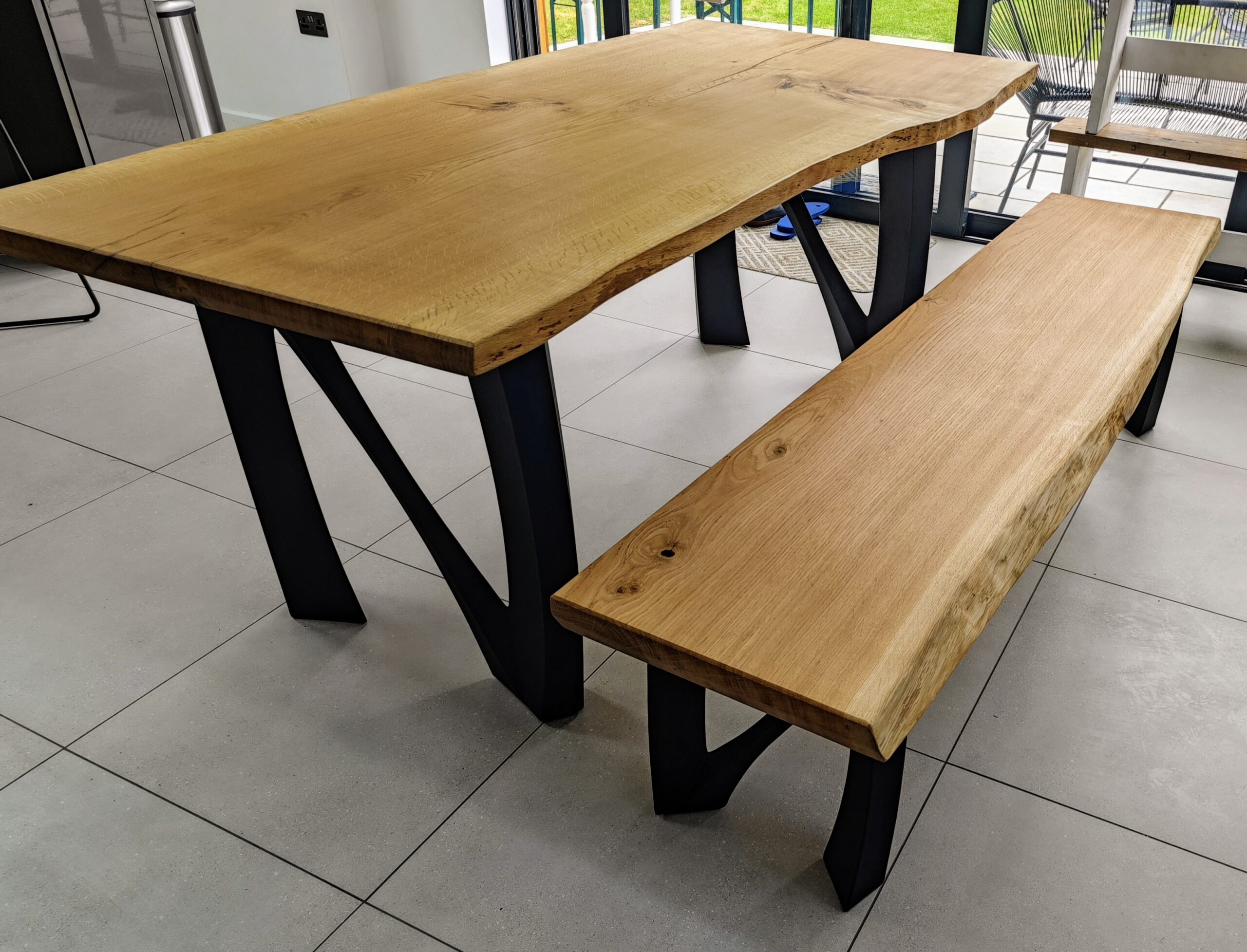
French oak is the quieter of the two. Its heartwood is a light to medium brown, often with a slight olive tone, and the grain runs fairly straight. The live edges on French oak slabs tend to be straight and uniform, which suits a room where you want the table to feel calm rather than wild.
We make each French oak top from a single tree, so the grain pattern and colour match across the whole surface. You can have it in its natural colour or stained to a walnut colour if you want something darker without changing species.
English elm is the more theatrical choice. The heartwood is a reddish brown, the paler sapwood usually shows as a clear band along the edges, and the interlocked grain produces swirling figure. English elm slabs are full of knots and features along the live edges, which can range from relatively straight to extremely wild. We can adjust the edge to suit you, from a gentle wave to something much more dramatic.
How they wear
On the Janka hardness test, which measures how well a wood resists denting, European oak scores about 1,120 lbf and English elm about 810 lbf. That makes oak nearly 40% harder, so if your table will take daily knocks from children, keys and dropped cutlery, oak has a real advantage.
Elm is still a strong hardwood. The Woodland Trust describes it as strong and durable, and lists its traditional uses as boats, furniture, wheel hubs, wooden water pipes, floorboards and coffins. Whichever you choose, we finish the top in either Rubio Monocoat Pure for a hard-wearing matt surface or multiple coats of Osmo high-gloss for a mirror-like shine.
Splitting, warping and stability
This is where the two woods differ in ways people don’t expect. Elm’s interlocked grain makes it very resistant to splitting. On the other hand, elm has a reputation for moving with changes in humidity, and the Wood Database describes its dimensional stability as poor.
Oak behaves the other way round while it dries. Timber drying guidance puts oak among the species most prone to surface checking, and it dries very slowly. Once dry, though, TRADA (the Timber Research and Development Association) puts European oak and European elm in the same “medium” movement class.
The practical answer is the same for both: the slabs must be properly dried before they are made into a table. Ours are kiln-dried to a moisture content of 8% or below. Our guide on why solid wood tables split and warp explains why that number matters.
Why English elm is so rare
Dutch elm disease is caused by two related fungi that elm bark beetles carry from tree to tree. According to Forest Research, within ten years of the epidemic that began in the 1960s about 20 million of the UK’s estimated 30 million-plus mature elms were dead, and by the 1990s the figure was probably well over 25 million.
English elm survives mainly as younger trees in hedgerows, which regrow from old root systems but become vulnerable to the beetles once they reach a certain size. The result is that wide slabs from big, mature English elms are hard to find. Because of that rarity, we buy and hold stock of large English elm slabs whenever we can.
How wide can each table be?
We use the fewest slabs possible and book-match them from the same log, so the grain mirrors itself across the centre of the table.
- English elm slabs usually come up to about 65cm wide, so two slabs make a table up to 1.3m wide. For a wider table, up to 1.5m, we use three.
- For French oak we source ultra-wide slabs, allowing tables up to 1.5m wide from just two book-matched slabs.
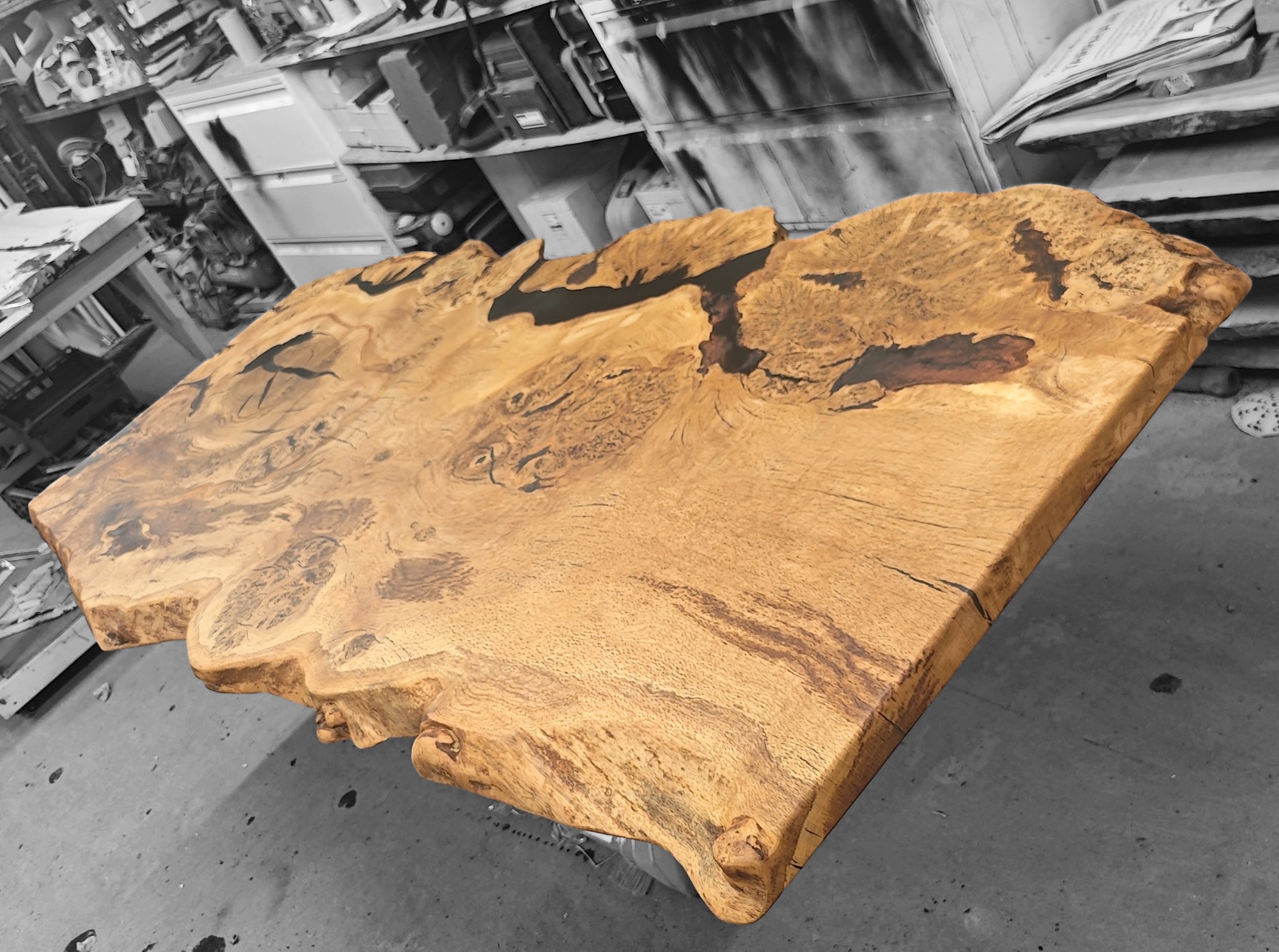
- If you want no join at all, we can make a table between 1m and 1.5m wide from a single slab of burr oak, often up to 60mm thick.
Not sure what width you need? Our dining table size guide covers seating, width and room space.

Which should you choose?
Go for French oak if:
- you want the colour and grain to be consistent from one end of the table to the other
- you would like a darker, walnut-coloured table
- the table will see heavy daily use and you want the harder surface
- you prefer a straighter, calmer live edge, or a chamfered edge all round
Go for English elm if:
- you want bold figure, knots and sapwood to be the main feature
- you like a warmer, reddish-brown tone
- you want dramatic live edges
- the rarity and history of the timber matter to you
Budgets for our bespoke tables run from roughly £2,000 to £10,000+, depending mainly on the rarity of the wood and the size of the table. The best way to decide is to look at finished tables in our French oak gallery and English elm gallery. We can also source almost any other species, including American black walnut and pippy oak.
Tip: if you are torn, ask us for a quote in both woods at the same size. Seeing the two prices and slab photos side by side usually makes the decision for you.
Quick answers
Is oak harder than elm?
Yes. European oak scores about 1,120 lbf on the Janka hardness test against about 810 lbf for English elm, so oak resists dents better.
Does English elm crack?
Its interlocked grain makes it very resistant to splitting, but like all solid wood it moves with humidity. That is why every slab we use is kiln-dried to 8% moisture content or below.
Can a French oak table be made darker?
Yes. We offer French oak in a natural colour or stained to a walnut colour.
How wide can an English elm table be?
Up to 1.5m. Elm slabs usually come up to about 65cm wide, so two book-matched slabs make a table up to about 1.3m wide, and three slabs take it to 1.5m.
Get a free quote in oak or elm
Tell us the size you need and the wood you are leaning towards, and we will come back with a quote and leg design options.
Request a free quote or call 01245 79 0182
Keep reading
More buying guides
 Live Edge vs Resin River Tables: An Honest ComparisonWhat separates a live edge table from a resin river table, where each works best, and how to choose between them.Read the guide
 What Size Dining Table Do You Need? Seats, Space and ShapesHow much table length each person needs, the best width and height, and how much clear space to leave around the table.Read the guide
 Why Solid Wood Tables Split and Warp (and How We Prevent It)Why solid wood moves, what causes splits and warping, and how kiln drying, sensible placement and simple care keep a table stable.Read the guide