
Why Solid Wood Tables Split and Warp (and How We Prevent It)
Why solid wood moves, what causes splits and warping, and how kiln drying, sensible placement and simple care keep a table stable.

Solid wood splits and warps because its moisture content changes: it shrinks as it dries and swells as it takes up moisture, almost entirely across its width rather than along its length. The classic cause of trouble is timber that was never dried enough for a centrally heated home, so it keeps shrinking after it arrives. Our slabs are kiln-dried to a moisture content of 8% or below, and sensible placement and care do the rest.
Wood never stops trading moisture with the air
A living tree is full of water. One UK timber drying guide estimates that a cubic metre of freshly felled oak holds around 540 litres. As the timber dries, it first loses the free water in its cells, which doesn’t change its size. Once it drops below what is called the fibre saturation point, around 25 to 30% moisture content for most species, the cell walls themselves start to give up water and the wood shrinks.
Wood is also hygroscopic: long after it has been dried, it keeps gaining or losing moisture to match the temperature and humidity around it. TRADA (the Timber Research and Development Association) sets out the rules of thumb that matter for a table:
- Timber does not shrink or swell lengthwise along the grain in any practical sense. The movement happens across the width.
- Across the width of a flat-sawn board, it shrinks or swells roughly 1% for every 3 to 5% change in moisture content.
- A flat-sawn board moves almost twice as much across its width as a quarter-sawn one.
- Seasonal changes of 3 to 6% in the moisture content of timber inside buildings are not uncommon.
That is why a 2.4m-long table never gets noticeably shorter, but a 1m-wide top can change width through the year.
What actually causes cracks and warping
Splits and checks
Wood loses moisture fastest from its surfaces and especially its ends. When the outside dries and shrinks faster than the core, the stress opens surface checks and end splits. Oak is one of the species most prone to checking as it dries, which is why it has to be dried slowly and carefully.
Cupping, bowing and twisting
Wood shrinks more along the direction of the growth rings than across them, and the grain in a real piece of timber is rarely perfectly straight. When the moisture content changes, those uneven forces pull the board out of flat. TRADA estimates that over 80% of in-service problems with wood are linked in some way to its moisture content, and explains that when timber is put into service wetter than the conditions it will settle to, two problems follow: shrinkage and distortion.
Why air-dried isn’t dry enough for a heated home
Traditional seasoning means stacking slabs outdoors, under cover, and letting them dry naturally. It works, but only so far. In the UK climate, air-drying outside can only bring timber down to around 14 to 20% moisture content, and a common rule of thumb is a year of drying for every 25mm of thickness.
A centrally heated house is much drier than that. The table compares air-dried timber with the in-service moisture contents that BS EN 942, the British Standard for joinery, gives for internal woodwork, as summarised by TRADA:
| Where the wood lives | Typical moisture content in service |
|---|---|
| Outdoors, air-dried in the UK | Around 14 to 20% |
| Unheated building | 12 to 16% |
| Heated to 12 to 21°C | 9 to 13% |
| Heated to over 21°C | 6 to 10% |
| Our kiln-dried slabs | 8% or below |
Here is what that gap means in practice. Take a flat-sawn slab that went into a house at 20% and settled at 10%. On TRADA’s rule of thumb, a 10-point drop means roughly 2 to 3% shrinkage across the width, or somewhere around 2 to 3cm on a 1m-wide top. Movement on that scale is enough to open cracks and pull a top out of flat.

How we reduce the risk
- Kiln drying to 8% or below. Our slabs are kiln-dried to a moisture content of 8% or below, which sits within, or just below, the range expected for a centrally heated home. The wood starts life in your house close to where it will settle, instead of shrinking into place.
- Fewer, matched slabs. We use the minimum number of slabs possible and book-match them from the same log, so the pieces either side of the join come from the same tree.
- Natural features dealt with honestly. Some slabs have natural cracks from the tree itself. With French oak, for example, we can choose slabs with large cracks and infuse them with resin as a feature.
- A protective finish. We finish tables in Rubio Monocoat Pure (matt) or multiple coats of Osmo high-gloss, both hard-wearing and non-absorbent. TRADA is clear that a finish slows down how fast wood responds to humidity but cannot stop its moisture content changing, so a finish helps rather than cures.
Solid wood will always move a little, and we are upfront about that. Our 2-year wood movement warranty covers cracks that open wider than 3mm and distortion, cupping or twisting of more than 1% of the table width. Hairline cracks of 3mm or less and normal seasonal movement are part of living with real timber.
Central heating, underfloor heating and sunny windows
As our policies explain, furniture close to underfloor heating, radiators, log burners, large south-facing glazing, bi-fold doors or other strong heat sources can move more than furniture kept in a stable environment. That doesn’t rule them out, but it is worth planning for:
- Keep the table a sensible distance from radiators and log burners rather than right up against them.
- If you have underfloor heating, avoid sudden big jumps in temperature and tell us when you order.
- If the table will sit in strong direct sun for hours a day, think about blinds, and tell us.
- After building work, wait until new plaster or screed has dried out before the table arrives. TRADA advises installing furniture only once a building has dried out, and warns against “baking” a new building by running the heating hard to speed things up.
Give it a year. Solid timber generally takes around 12 months to fully acclimatise to a new home, so a little movement in the first year is normal. Unless something is severe, it is best to let the table go through a full cycle of seasons before deciding whether any work is needed.

Everyday care that actually helps
- Wipe spills up promptly rather than leaving them to soak in.
- Use mats or trivets under hot dishes and pans.
- Keep conditions in the room as steady as you reasonably can. Timber averages out small daily swings in heating, but large changes in humidity are what make it move.
Choosing a species? Our French oak vs English elm guide explains how each behaves as it dries.
Quick answers
Will my oak table crack?
Fine hairline checks can appear as solid oak settles into a new home, which is normal. Large cracks are far more likely when timber was too wet when it was made; ours is kiln-dried to 8% or below, and our warranty covers cracks wider than 3mm for two years.
Is underfloor heating bad for a solid wood table?
It isn’t a reason to avoid solid wood, but tables near underfloor heating can move more. Keep temperature changes gradual and let us know when you order.
What moisture content should a wood table be?
For a home heated above 21°C, BS EN 942 expects internal woodwork to settle at 6 to 10%. Our slabs are kiln-dried to 8% or below.
Does a good finish stop wood moving?
No. A finish slows the rate at which wood takes up or loses moisture, but it cannot stop it.
Ask us about your room
Tell us about your space, including any underfloor heating or big south-facing windows, and we will advise on the right wood and quote for your table.
Request a free quote or call 01245 79 0182
Keep reading
More buying guides
 Choosing Steel Legs for a Live Edge or Slab TableLeg styles, height, legroom, steel thickness and powder coating: what to check when choosing steel legs for a heavy slab top.Read the guide
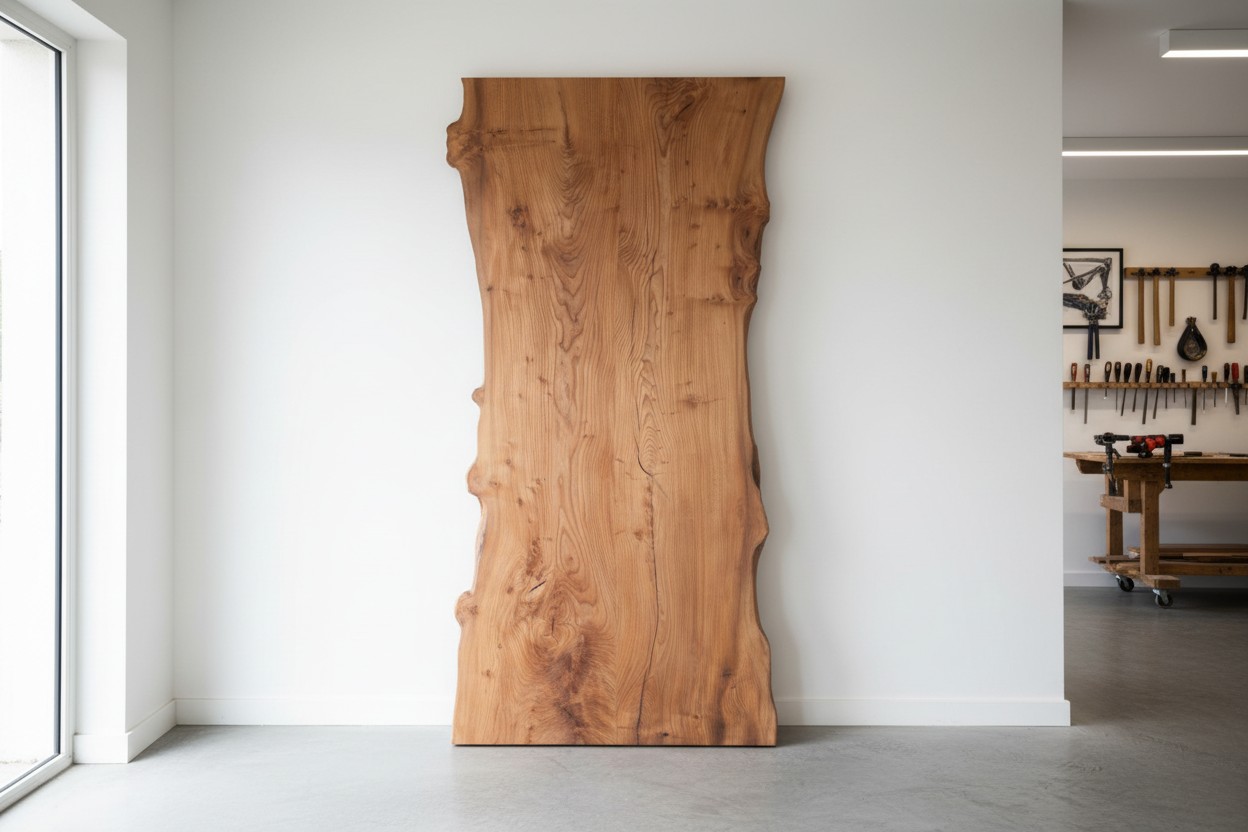 French Oak vs English Elm: Which Wood for Your Dining Table?How French oak and English elm compare on colour, grain, hardness, stability and rarity, and which one suits your dining room.Read the guide
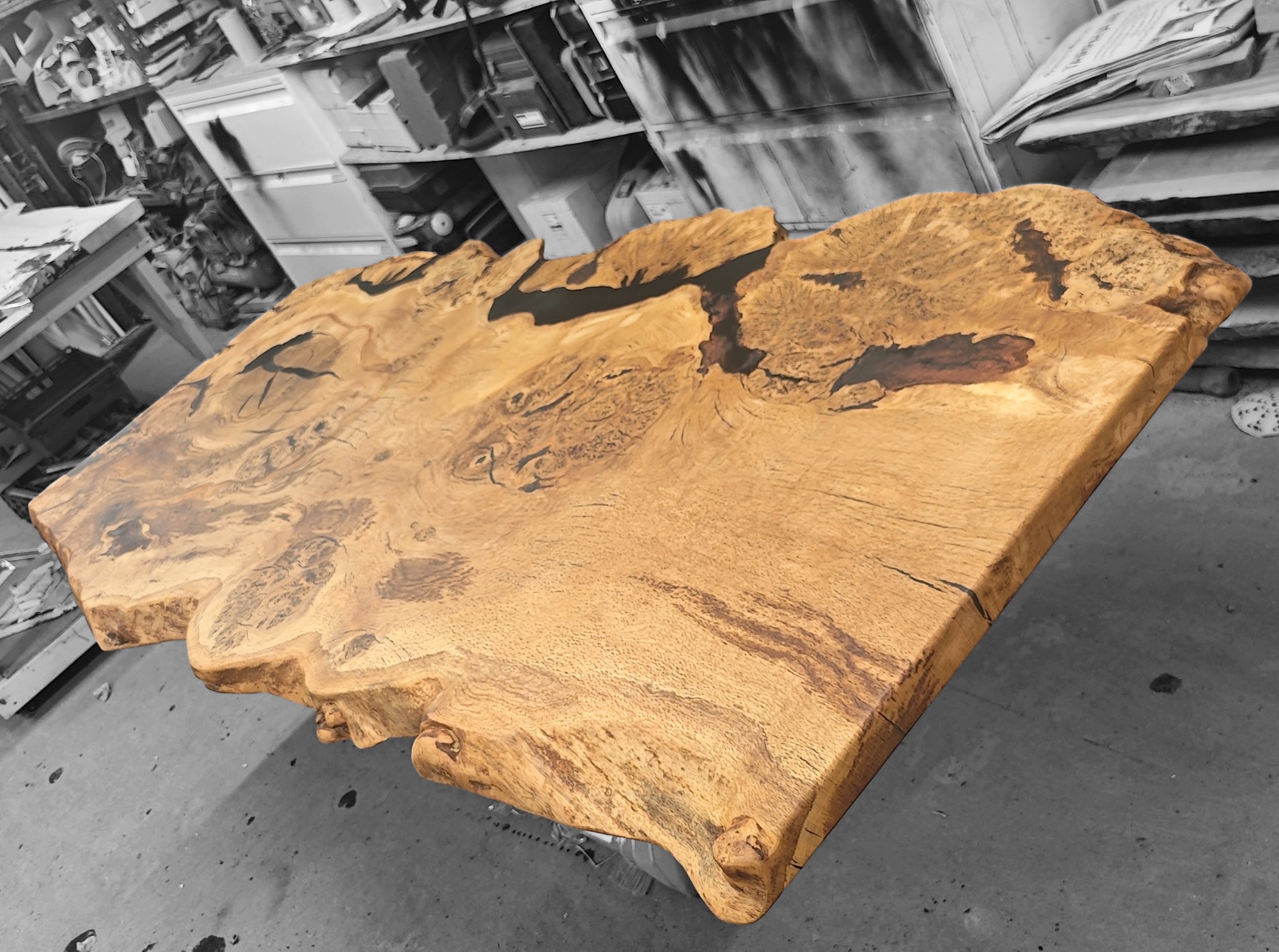 Live Edge vs Resin River Tables: An Honest ComparisonWhat separates a live edge table from a resin river table, where each works best, and how to choose between them.Read the guide